
Documentation Support
End-to-end preparation and submission of export and transit documents for smooth international shipping from Europe.
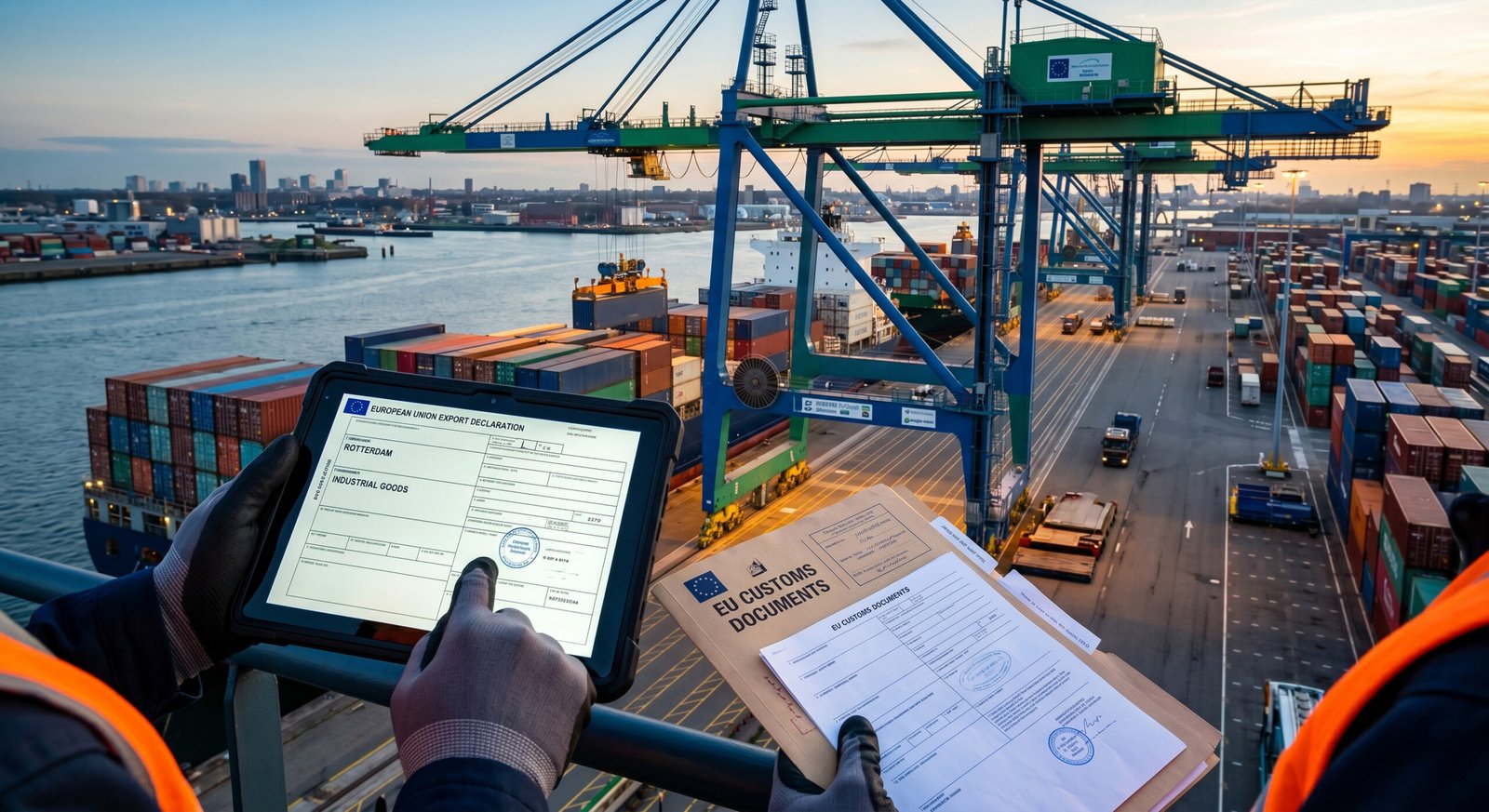
Exporting goods from Europe requires more than booking freight. Every shipment leaving the EU must be supported by correct export and transit documentation submitted to customs authorities and port community systems such as Portbase in Rotterdam and C-point in Antwerp. Missing or incorrect paperwork can lead to delays, fines, storage costs and shipment holds at the terminal.
bluegate provides full export documentation support for exporters, traders and freight forwarders who need fast, compliant and reliable customs processing. We prepare, submit and manage all required export declarations and certificates to ensure your cargo moves smoothly through European ports and airports.
What Documentation Support Includes
Export declarations
(EX-A / EX1)
Transit documents
(T1, T2, T2L)
EUR.1, A.TR and Certificates of Origin
Digital submission via Portbase and C-point
CargoX ACI Filing for Egypt
Export accompanying documents (EAD)
Compliance and customs advisory
Who bluegate’s
Documentation Support Is For
This service is designed for exporters, distributors, traders and freight forwarders shipping goods from Europe to the Middle East, Africa and global destinations. It is particularly valuable for companies that do not have in-house customs expertise or need a reliable partner to manage export paperwork on their behalf.
Why bluegate’s Documentation Support
One partner for freight and customs
Fast and compliant processing
Reduce delays and avoid penalties
Support for regular and one-off shipments
FAQ
When do I need an EX-A (export) declaration instead of a T1 transit declaration?
Use an EX-A/EU-A (export) declaration whenever the goods are already in free circulation (i.e. Union origin) and you are exporting outside the EU. By contrast, use a T1 transit declaration when the goods are not in free circulation (non-Union goods) moving within EU territory. In short: Union-origin goods export outside EU ⇒ EX-A/EU-A; non-Union goods traveling under customs control ⇒ T1.
What is the difference between an EX-A and a EU-A export declaration?
n EX-A is used for exports to non-EU, non-EEA countries (outside all European customs unions). An EU-A is used when exporting Union-origin goods to certain European countries outside the EU (e.g. UK, Norway, Switzerland) under special arrangements. Both are filed via the Dutch customs system (AGS/DMS) for shipments of goods in free circulation.
How do I prove my goods have left the EU to apply the 0% VAT rate?
For 0% VAT on exports, you must keep documentary proof of export. At minimum, retain a copy of the export declaration (with MRN), the shipping document (freight bill), and any transport invoice or destination import certificate that shows the goods left EU. Dutch tax authorities specifically advise keeping: freight bill copy, export declaration, carrier invoice, and the importer’s customs release. These prove goods exited the EU, allowing you to zero-rate the VAT.
Who is responsible for filing the export declaration and documents – the exporter or the forwarder?
Legally, the exporter (the person or company with goods ownership) holds the responsibility for accurate export paperwork. In practice, the exporter typically authorizes a freight forwarder or customs broker as the “declarant” to prepare and submit the EAD/MRN. The declarant (often the forwarder/broker) ensures the EX-A/EU-A is lodged. Ultimately the exporter is liable for correctness, but the forwarder is usually engaged to handle the technical filing.
What if I miss the deadline to submit an export declaration before the vessel departs?
If the export declaration (EAD) or port notification is not filed in time, customs will not release the goods for export. In practice, this usually means the container cannot be loaded on that vessel (similar to “no-doc, no-load”). You would need to wait for a later vessel and re-file the docs promptly.
What is the difference between a T1 and a T2 transit declaration?
A T1 transit declaration is used for non-Union (non-free-circulation) goods moving within the EU under customs control. For example, goods from outside the EU passing through to another EU country use T1. A T2 declaration is used for Union-origin goods when they transit between EU customs offices. In effect, both serve to move goods “duty-unpaid,” but T1 is for non-EU goods, T2 for EU goods that temporarily enter non-EU territory (or move within EU tax-exempt zones).
When should I use a T1 transit document instead of an export declaration?
Use a T1 when the goods are not yet in free circulation (they haven’t had import duty paid in the EU). In other words, if you bring non-EU goods into a Dutch (or Belgian) inland point for onward transport under customs control, file T1. If the goods are in free circulation, you would normally export them via EX-A/EU-A. In practice, non-Union goods leaving the EU use T1; Union goods leaving the EU use export declaration.
What is a T2L document and when is it required?
A T2L (“Transit 2 Leaflet”) is a simplified certificate that proves Union origin of goods in transit. It is required when Union goods transit outside the EU’s VAT territory (e.g. between EFTA countries or through Belgium) but maintain EU origin. Since September 2024 (Belgium) and earlier in the Netherlands, T2L must be issued and managed electronically via the Port Community System (PoUS/PCS). If your goods have EU status and you move them under transit, T2L provides customs with proof of their origin without a full declaration.
How do I apply for NCTS to file a T1/T2 declaration?
You must register with the national customs system for electronic transit (NCTS). In the Netherlands, that means applying for access to NCTS (formerly AGS). You can register by submitting the official electronic messaging application form to Dutch Customs. Once your company is enabled, you can file T1/T2 transit declarations via NCTS.
Who is responsible for preparing the transit (T1/T2) declaration – exporter or forwarder?
The responsible party is the declarant, which in export cases is usually the exporter or their authorised agent. In practice, exporters often ask a licensed customs broker or freight forwarder to act as declarant. That means the broker/forwarder prepares and submits the T1 under the exporter’s authorisation. Legally the exporter is ultimately liable, but the forwarder typically handles the paperwork.
When do I need a EUR.1 certificate instead of just an invoice declaration?
A EUR.1 certificate is used when exporting Union-origin goods to countries with which the EU has a trade agreement (for duty reduction). However, for low-value shipments (≤€6,000), an ordinary invoice declaration suffices instead of EUR.1. In practice, for any sizeable shipment to a preferential country, use EUR.1 to claim reduced tariffs.
How do I apply for a EUR.1 certificate or a Certificate of Origin (CVO)?
In the Netherlands, you request either document from the Chamber of Commerce (KVK). For a EUR.1, you apply to KVK (Netherlands Enterprise Agency). For a non-preferential CVO (for any country requiring proof), you also apply at KVK. In both cases, you must fill in details of the shipment, product origin, and may need to submit invoices or supplier declarations.
Who issues the EUR.1 certificate in the Netherlands and is there a minimum shipment value?
The Chamber of Commerce (KVK) issues EUR.1 certificates. There is no value limit for EUR.1 itself, but under €6,000 in goods value you are not required to use EUR.1 (a simple invoice declaration suffices). To apply, the exporter completes the form and submits it to KVK for validation.
What is a supplier’s declaration of origin (LVO) and when is it needed?
A Supplier’s Declaration (LVO) is a statement from your supplier confirming where the goods were made. It is needed when applying for a Certificate of Origin (CVO) if the goods are of non-preferential origin (i.e. no trade agreement). If you bought goods from an EU supplier, that supplier can issue an LVO to you for export purposes. If your supplier is outside the EU, you must instead obtain their local Certificate of Origin as proof.
If my supplier is outside the EU, how can I prove the origin to obtain a CVO?
If the supplier is outside the EU, they cannot issue an LVO. Instead you need a Certificate of Origin from the supplier’s country. You present that to Dutch customs or the Chamber when applying for your CVO. Without it, you generally cannot get a Dutch CVO.
What is an A.TR certificate and when is it used for trade with Türkiye?
An A.TR is a special export certificate for the Turkey customs union. It allows EU exporters to ship to Türkiye duty-free and vice versa. You use it when exporting from the EU to Türkiye (or importing from Türkiye) for goods that qualify under the customs union. It shows the goods’ origin so that no import duty is charged by Türkiye.
How do I obtain an A.TR certificate for exports to Türkiye?
In the Netherlands, the exporter fills in an A.TR form and has it validated by Dutch Customs. You must have your goods in free circulation (or have them imported and then re-exported). Customs will stamp or electronically validate the A.TR, making it valid for 4 months. You can get blank A.TR forms from licensed printers or the customs authority, and no value threshold applies (even small shipments can use A.TR).
What documents do I need to attach when applying for a Certificate of Origin?
When applying for a CVO at the Chamber, you must provide evidence of origin. This can include production descriptions (if you are manufacturer) or supplier declarations (LVO) for purchased goods. If you imported goods from outside the EU, you show the foreign CVO. KVK may also ask for invoices or other proof to verify origin. The exporter is responsible for completing the certificate form accurately.
Who is responsible for filing the Egypt ACI – the exporter or the freight forwarder?
The exporter (or their freight agent in the origin country) must file the ACI on CargoX. The foreign freight forwarder mainly needs to register on CargoX and verify their company. They provide information to their Egyptian agent, but they themselves do not upload the documents – the exporter (or supplier) does.
When should I submit the ACI filing for my export – is there a deadline?
There is no fixed deadline, but you must complete the ACI before the goods depart. Egyptian guidance says exporters should file as soon as all documents are ready. In other words, file early to take advantage of the “green channel” benefits. The critical point is that the ACID is generated prior to shipment departure; there’s no explicit late-filing penalty, but late filing means losing expedited customs release.
What is an ACID number and how do I obtain it?
An ACID is the Advance Cargo Information Declaration number. You obtain it by filing an ACI envelope on CargoX (the digital platform). First you (exporter) login to CargoX and have your company verified. Then you share your details (with the importer) and compose the ACI envelope; upon submission, CargoX issues an ACID.
What are common errors shippers make when preparing export paperwork?
Frequent mistakes include mismatched or missing data (incorrect HS codes, wrong commodity descriptions, inconsistent values) and delayed filing. Another is failing to check origin declarations (e.g. missing supplier’s LVO) or tardy completion of new systems (like PoUS). Late submission past cut-off times is also a common error, causing refusals. Double-check all input fields, and file well before deadlines to avoid these pitfalls.
How do I get proof of export if the MRN hasn’t been issued yet?
You can use interim documents as evidence: a copy of the submitted export declaration or proof of lodgement (a lodgement receipt) combined with the freight bill. Once Customs processes the declaration, the MRN can be downloaded from their portal. Keep any carrier transport docs and a copy of the export application to show goods are en route out of the EU.